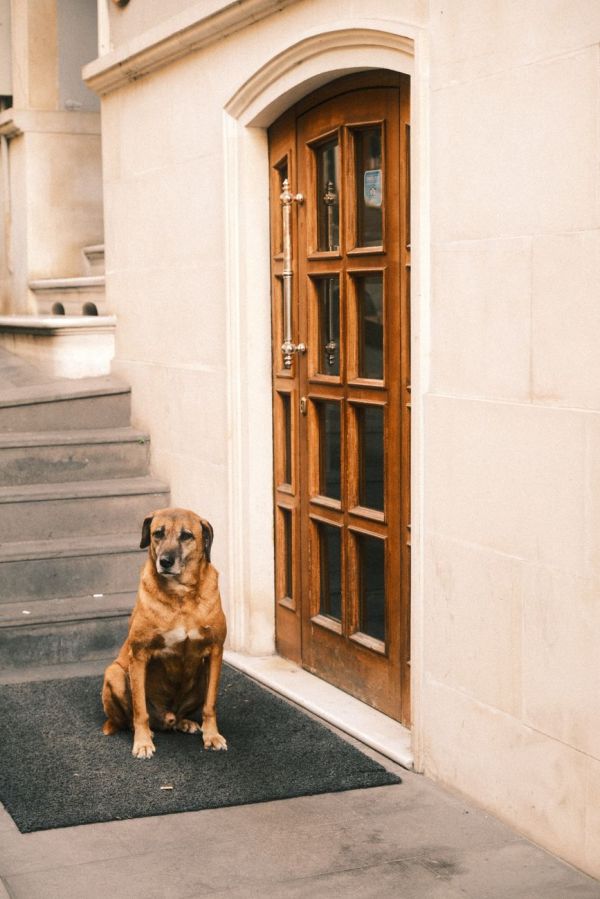
You come home to a chewed door frame. Your neighbor texts that your dog howled for an hour. You check the camera and see your dog pacing, panting, and scratching at the door the moment your car pulls away.
None of that means your dog is angry with you, or trying to punish you for leaving. For a lot of dogs, being alone triggers real panic — and panic is not a behavior problem you can scold away.
It also does not mean you did something wrong. Separation anxiety shows up in rescue dogs and puppies from breeders, in confident dogs and shy ones. The good news: it is one of the most workable behavior problems out there.
7 Signs Your Dog May Have Separation Anxiety
One rough homecoming does not automatically mean separation anxiety. Look for a pattern — and for more than one of these signs, happening mostly when your dog is alone:
- Howling, barking, or whining that starts soon after you leave and goes on for most of the time you are gone.
- Pacing, circling, or restless movement — often right by the door or window you left through.
- Destructive chewing or scratching aimed at doors, window frames, and other exits, rather than random household items.
- Toileting in the house even though your dog is house-trained and was just outside.
- Drooling, panting, or shaking that starts as you get ready to leave — keys, shoes, and coats can become triggers.
- Refusing food, treats, or a favorite toy the moment you walk out, then eating normally when you return.
- Following you from room to room and getting distressed when you close a door, even when you are still home.
Why It Happens
Separation anxiety is panic, not spite. Your dog is not getting revenge for being left alone — dogs do not think that way. Being alone feels unsafe to them, and the chewing, howling, and pacing are attempts to cope with that fear or to get back to you.
It often starts after a change: a move, a new schedule, a family member leaving, or a long stretch of togetherness that suddenly ends. Puppies and newly adopted dogs are especially prone to it, because being alone is a skill they have not practiced yet.
The important part: punishment makes it worse. Scolding a dog for what it did while you were gone only adds fear to the fear. You cannot punish a panic attack away.
What Actually Helps
There is no quick fix, but there is a method that works: gradual departures. You start with absences so short your dog barely notices — a few seconds — and build up slowly, seconds to minutes, over days and weeks. The goal is to teach your dog that you always come back, without ever asking for more alone time than they can handle.
A few rules make the practice work:
- Start tiny. Step outside, count to five, come back in. If your dog stays calm, that is a win. Repeat it, then build up in small steps.
- Keep departures and arrivals boring. No big goodbyes, no excited hellos. Picking up your keys should become the least interesting part of the day.
- Practice on camera. A phone camera or a pet camera lets you see exactly when your dog starts to worry, so you can keep the next session shorter than that moment.
- Never practice panic. If your dog is already howling or panicking, the session was too long. Go shorter next time.
- Reward calm, not the exit. Quiet, relaxed behavior while you are gone is what you want more of — and that is exactly what positive reinforcement is built for.
You will find more step-by-step training guides on our Training page.
When It’s Beyond DIY
Most mild cases improve with patient, gradual practice. But get extra help quickly if your dog hurts itself trying to escape, breaks teeth or claws on doors and crates, jumps through windows, or panics so hard it cannot eat, drink, or settle at all.
That is a job for your veterinarian first — to rule out pain or illness and to talk about medication that can make training possible — and then for a certified separation anxiety trainer (CSAT), who specializes in exactly this problem. You are not failing your dog by asking for help. You are giving the training a fair shot.
Quick Answers
Is separation anxiety my fault? No. It is common, and it is not caused by spoiling your dog or loving them too much. It is a fear response, and fear can be worked on.
Will getting a second dog fix it? Usually not. A second dog can be company, but it does not teach the anxious dog that being alone is safe. Many stay anxious even with a friend in the house.
How long does it take to improve? It varies a lot. Some dogs make real progress in a few weeks of steady practice; others need months.
Ready to Help Your Dog Feel Safe Alone?
Start with the free Beginner Dog Training Checklist — a simple first step you can use today.
For the full at-home plan, the Separation Anxiety Alone-Time Kit on Etsy is a printable workbook with the camera test, a ladder builder, and a 30-day plan.
For the deeper teaching behind the kit, the companion book Calm When You’re Gone by Rockynus is now live on Amazon.

